
One Form Is Not a Dataset: Training Payroll Extraction Across the 941 Family
The short answer: Payroll extraction models trained only on the base Form 941 learn where fields sit on one page, not what the fields mean. When production sends a 941-X, Schedule R, or 941-SS, the layout changes and the model fails without knowing it has failed. Training across all five 941-family variants, with tax math that reconciles, forces the model to learn the concepts instead of the coordinates.
Say you're building payroll document extraction for an accounting automation product, a lending underwriter, or a payroll-provider migration tool. You collect or generate a few thousand Form 941s, train, and hit good field-level F1 on your held-out set. You ship.
Then production sends you a 941-X. Or a Schedule R from a CPEO client. Or a 2023 941-SS out of a Guam employer's back-file. The IRS discontinued that form after 2023, but years of filings are still sitting in archives waiting to be processed. Your model has only ever seen the geometry of the base quarterly return, so it confidently extracts garbage. And because it was trained on exactly one layout, it doesn't even have the calibration to know it's out of distribution.
The base 941 is not the payroll extraction problem. The 941 family is.
What forms are in the Form 941 family?
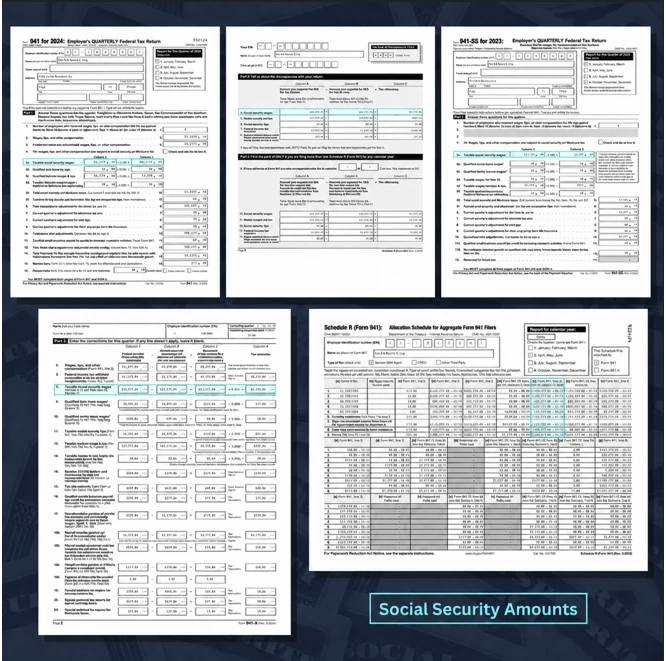
In production, "Form 941" is really at least five related filings, each with its own layout, its own field set, and its own reason to land in your pipeline.
| Form | What it is | Why it shows up in your inbox |
|---|---|---|
| 941 | Employer's Quarterly Federal Tax Return: wages, withheld income tax, Social Security and Medicare taxes | The base case. Four per employer per year. |
| 941 Schedule D | Report of discrepancies caused by acquisitions, statutory mergers, or consolidations | Reconciling W-2 totals against 941 totals after a corporate change |
| 941 Schedule R | Allocation schedule for aggregate filers (PEOs, CPEOs, §3504 agents) | One filing fans out into per-client allocation rows |
| 941-SS | The territories variant for American Samoa, Guam, CNMI, and the U.S. Virgin Islands. Discontinued after 2023; territory employers now file the base 941. | Back-file and archive processing of pre-2024 territory filings |
| 941-X | Adjusted return or claim for refund, correcting a previously filed 941 | A corrected-versus-original layout with four value columns on each line |
All five share overlapping concepts: an EIN, a reporting period, wage totals, Social Security and Medicare figures, and amounts that must reconcile. But they express that core in five different page geometries.
The 941-X is the hardest case for a model that only knows the base form. Each line carries a corrected amount, the amount originally reported, and the difference between them, followed by a tax correction. The same semantic field appears several times on one line, each time with a different meaning.
Why does layout variety matter more than document volume?
A model trained on 10,000 base 941s has seen one mapping from concept to position. "Total taxes after adjustments" lives at one (x, y) on one layout. The cheapest thing for the model to learn is the position, not the concept, and gradient descent tends to take the cheapest path. Researchers call this shortcut learning. The result is a very accurate lookup table for a single page geometry.
Train the same model across the five family variants and the positional shortcut stops paying. Social Security amounts now appear at five different positions, in five typographic contexts, and once inside a corrected-versus-original column set. The only representation that explains all the training data is the semantic one: find the field by reading the label text and the structural context, not by memorizing coordinates.
In effect, a form family is a natural curriculum for layout invariance. The concepts hold constant while the geometry varies, which is exactly the contrast a model needs to learn the concept instead of the position.
This is the same argument behind multi-font training in OCR and multi-template training in invoice extraction. Government form families have one advantage over both: the concepts are defined by the same statute. A Medicare wage total on a 941-SS means precisely what it means on a 941, so the variation is pure layout signal with no label noise.
How to measure whether your model generalizes
A form family also gives you the eval that actually predicts production behavior: hold out an entire variant. Train on 941, Schedule D, Schedule R, and 941-SS, then test on 941-X.
In-distribution F1 tells you the model fits. Held-out-variant F1 tells you it generalizes. The gap between those two numbers is your real production risk on the next form revision the IRS publishes.
The part you can't fake: why synthetic payroll data must reconcile
Layout variety is necessary but not sufficient. If the field values are random, the model trains on documents whose internal logic is broken, and payroll forms are dense with internal logic.
On a real 941, the tax math is mechanical. Social Security tax is taxable Social Security wages × 12.4% (employer and employee shares combined). Medicare tax is Medicare wages × 2.9%. Additional Medicare Tax withholding is 0.9% of wages over the threshold. Line totals reconcile down the page into total taxes after adjustments. A downstream validation layer will almost certainly recompute these values, and an extraction model can learn to use the relationships between them as a signal.
SymageDocs generates 941-family documents from a model of an employer's payroll records: an employee roster with individual wage draws, tax lines computed per statute, and totals that sum. The Social Security line on a generated 941 is taxable Social Security wages times 12.4%, to the cent, because that's how the field is computed, not sampled. It's the same approach that keeps W-2 and 1040 values consistent with each other, applied to the employer side of payroll. (For more on why random field values fall short, see Why Faker Isn't Enough for Document AI Training.)
A model trained on forms where line 5a × 12.4% never equals the printed tax line learns that numeric reconciliation carries no information. A model trained on forms where the math holds can use every total as a cross-check on every component field. You want your training distribution to reward the second behavior, because production documents (the non-fraudulent ones) have it.
How do you generate a 941-family training set?
Here's the whole pipeline against the live API. Every form ID carries its family prefix, so enumerating the 941 cluster is a one-liner:
# pip install symagedocs
from symagedocs import Client

client = Client()  # reads SYMAGEDOCS_API_KEY from the environment

forms = client.forms.list(category="tax")
family = [f for f in forms if f.id.startswith("irs_f941")]

for f in family:
    print(f"{f.id:28s} {f.name} ({f.field_count} fields)")
Generate a per-variant training corpus, one job per variant. Each job gets its own fixed seed range, so every run is reproducible and version-controllable, and no two variants are filled with the same people and values. That separation is what keeps the held-out-variant evaluation honest:
jobs = {}
for i, form in enumerate(family):
    job = client.generate.create(
        form.id,
        quantity=200,
        output_formats=["pdf_typed", "png_typed"],
        degradation_profile="mixed",  # clean, scanned, faxed, photographed
        seed=4242 + i * 200,  # a distinct seed range for each variant
    )
    jobs[form.id] = job.job_id

for form_id, job_id in jobs.items():
    client.generate.wait(job_id)
    client.generate.download(job_id, "dataset", f"./{form_id}.zip")
Every bundle includes structured JSON ground truth, CSV, and per-page FUNSD annotations: entity labels, bounding boxes, and the word-level breakdown each entity is built from. That converts to BIO tags in a few lines for sequence-labeling pipelines, and Donut is available as an export option if you're training OCR-free models. If you'd rather stream the annotations than unpack zips:
for ex in client.generate.iter_training_examples(jobs["irs_f941_standard_2024"], format="funsd"):
    entities = ex.funsd.form  # FUNSD entities: {id, text, box, label, words, ...}
    labels = [e["label"] for e in entities]
    print(ex.item_id, f"page {ex.page_index}:", len(entities), "entities,",
          labels.count("question"), "questions,", labels.count("answer"), "answers")
The held-out-variant experiment is then just dataset bookkeeping. Concatenate four variants into the training split, reserve the fifth for eval, and compare per-field F1 on the fields the held-out variant shares with the training set against the in-distribution number. Run it five times, rotating the held-out variant, and you have a generalization profile for the whole family. That takes about a thousand documents that would be effectively uncollectable as real data. (When did you last see a labeled corpus of pre-2024 941-SS filings from the Northern Mariana Islands?)
For a step-by-step walkthrough of fine-tuning on this output, see Generate a Synthetic FUNSD Dataset for LayoutLMv3 Fine-Tuning.
Does this apply beyond payroll?
The 941 family is the cleanest example, but the same structure runs across the SymageDocs catalog of 75 public forms, from the IRS payroll and income-tax families through CMS-1500 healthcare claims and five commercial invoice templates.
The adjacent payroll cluster alone adds Form 940 with its Schedule R and Form 940-B (Request for Verification of Credit Information Shown on Form 940), the W-2 in multiple revision years, the W-4, and the W-9, all sharing entities and concepts with the 941 family. The 1040 family ships in six variants, including 1040-SR, 1040-NR, 1040-X, 1040-ES, and a 1988 revision for historical-archive work. The 1120 corporate family comes in five. Forms with multiple revision years, like the W-2 in 2025 and 2026, give you the temporal version of the same variety, which is what protects you when next year's layout shifts.
If you're building extraction for any of these domains, the question to ask of your training set isn't "how many documents?" It's "how many distinct mappings from concept to geometry?"
One is a lookup table. Five is the beginning of a model.
Get started free
New SymageDocs accounts start with 1,000 free credits. The five-form 941 family set (one clean typed PDF of each variant) runs 216 credits, so every variant goes through your pipeline before you spend anything.
pip install symagedocs, list the tax category, and see the family for yourself. Start for free →
How the 216 credits break down
A typed PDF costs 20 credits, plus 2 for every 25 fields (or part of 25) beyond the first 25.
| Form | Credits |
|---|---|
| 941 (109 fields) | 28 |
| 941 Schedule D | 24 |
| 941-SS | 30 |
| 941-X (375 fields) | 48 |
| 941 Schedule R (828 fields) | 86 |
| Total | 216 |
With mixed degradation (+25%), each set is about 271 credits, so the full 200-per-variant corpus in the code above is paid-tier scale, at about 54,000 credits.
Frequently asked questions
Was Form 941-SS discontinued? Yes. The IRS discontinued Form 941-SS after the 2023 tax year. Employers in American Samoa, Guam, the CNMI, and the U.S. Virgin Islands now file the base Form 941, but pre-2024 941-SS filings still appear in archive and back-file processing.
What is the difference between Form 941 and Form 941-X? Form 941 is the original quarterly return. Form 941-X corrects a previously filed 941, reporting the corrected amount, the originally reported amount, and the difference in separate columns, so its layout is very different from the base form.
Why do extraction models trained on one form fail on related forms? A model trained on one layout tends to learn where each field sits on the page rather than what the field means. When a related form moves those fields, the model has nothing to fall back on.
How do you test whether a document extraction model generalizes? Hold out an entire form variant during training and evaluate on it. The gap between in-distribution F1 and held-out-variant F1 estimates how the model will perform on layouts it hasn't seen.
What annotation formats does SymageDocs export? Every job ships with structured JSON, CSV, and per-page FUNSD annotations. Donut is available as an export option, and FUNSD output converts to BIO tags in a few lines.
Ready to generate synthetic document data?
Start with 500 free credits. No credit card required.
Start for Free